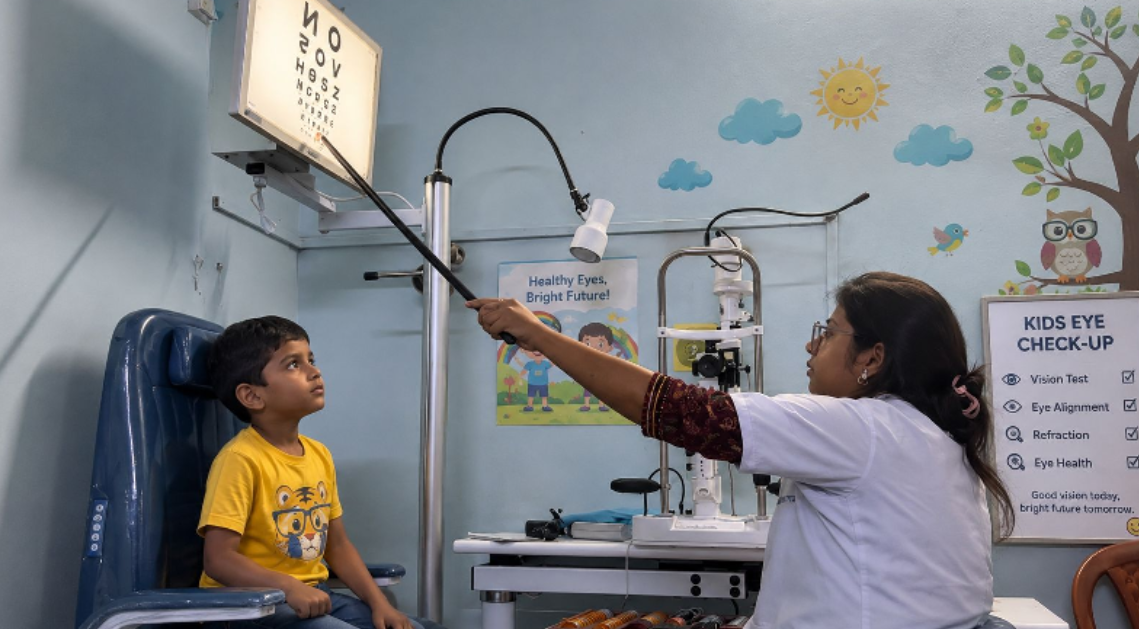
Every optometrist performing a comprehensive pediatric eye examination should assess a child’s visual history, objective refraction, eye alignment, binocular function, and internal/external eye health.
-
History and General Observation
Visual Acuity and Functional Visual Acuity:
1. Infants (Birth to 24 Months):
Preferential Looking (Teller Acuity Cards): Uses cards with stripes of varying widths paired with a blank side; the optometrist observes if the infant’s gaze is naturally drawn to the patterned stripes.
2. Toddlers and Preschoolers (2 to 5 Years):
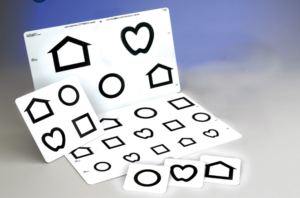
3. School-Age Children (5+ Years):
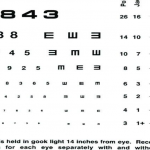
Snellen or Sloan Letter Charts: Standard linear letter charts used once the child reliably knows their alphabet and can read individual lines
Test using age-appropriate tools like fixation targets for infants, LEA symbols or matching cards for toddlers, and standard charts for older children.
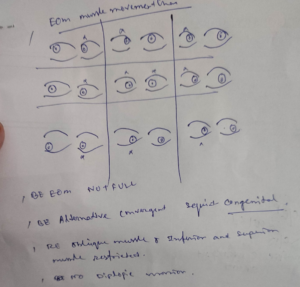
Ocular Alignment and Motility Extraocular Movements:
Assess tracking in the cardinal positions of gaze.
An ocular motility measurement is a routine eye test where an optometrist checks how well your eye muscles move your eyes in different directions.
How the Test Works
Refraction and Focusing Retinoscopy: Use objective retinoscopy (ideally cycloplegic) to measure refractive errors like nearsightedness, farsightedness, or astigmatism without relying on verbal feedback.
Cycloplegia: Apply cycloplegic eye drops when needed to temporarily relax the ciliary muscle for an accurate prescription and internal health evaluation.
Observing the reflex: The doctor watches the red reflection (red reflex) bouncing back from the retina
Ocular Health Pupillary Responses: Test direct and consensual reactions to light.
Red Reflex: Check for opacities, cataracts, or retinoblastoma.
Anterior and Posterior Segments: Examine the eyelids, cornea, iris, lens, and retina using direct ophthalmoscopy or specialized magnified viewing.
Special Screening
Recommended Schedule for Child Vision Screenings
A vision screening is a more efficient eye exam. A child is “screened” for eye problems and referred to an ophthalmologist for a comprehensive exam if needed.
Newborn
An optometrist should examine a newborn’s eyes to check for basic indicators of eye health. It may include testing for:
An optometrist should do a comprehensive exam if the aby is:
6 to 12 months
A second screening should be done during the child’s first year of life. This screening is usually done at a well-child exam between 6 and 12 months. Your child’s pediatrician or other health care professional should:
12 to 36 months
Between 12 and 36 months, a child is checked for healthy eye development. There may be a “photo screening” test. A special camera takes pictures of your child’s eyes. These pictures help find problems that can lead to amblyopia (lazy eye). If they see a problem, your child may be referred to an optometrist.
3 to 5 years
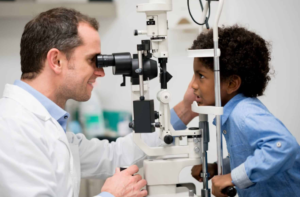
Between 3 and 5 years, a child’s vision and eye alignment should be checked. Visual acuity (sharpness of vision, like 20/20 for example) should be tested as soon as the child is old enough to read an eye chart.
Many children are somewhat farsighted (hyperopic), but can also see clearly even at distance. Most children will not require glasses or other vision correction. If the child struggles with the eye chart, photoscreening may be used to test vision.
An optometrist should see your child if the screening shows signs of:
Begin treatment for these problems as soon as possible—getting early treatment for your child is the best thing you can do to protect their vision.
5 years and older
At 5, children should be screened for visual acuity and alignment. Nearsightedness (myopia) is the most common problem in this age group. It is corrected with eyeglasses. An optometrist should examine a child with misaligned eyes or signs of other eye problems. Children treated with growth hormone therapy should have their eyes tested before and during treatment.
Eye testing for older children (6 to 18 years)
A comprehensive exam for an older child is similar to that of a younger child, but includes additional tests of specific visual skills that are essential for reading, learning, and even sports performance.
The following skills should be tested during an eye exam:
1. Eye Focusing:
2. Eye tracking: the ability to move the eyes to follow a line of text on a page, or follow a moving object like a ball thrown in the air.
3. Eye teaming: the ability to use both eyes together, in coordination when reading
4. Eye-hand coordination: the ability to use visual information to accurately direct the hands when hitting a ball or drawing a picture.
5. Visual perception: the ability to visually organize images on a page into letters, words, and ideas; and to comprehend and recall text.
6. Recognition: the ability to distinguish between letters like “b” and “d”.
7. Comprehension: the ability to visualize or imagine in our mind the scene of a story
8. Retention: the ability to remember and recall details