Introduction –
Managing irregular corneas has always been one of the most challenging
areas in clinical optometry. Unlike regular refractive errors such as myopia
or hyperopia, irregular corneal conditions distort vision in a way that cannot
be fully corrected with standard spectacles or even conventional soft
contact lenses. Over the years, scleral lenses have emerged as a highly
effective and transformative solution for such cases.
In my experience, scleral lenses are not just another contact lens
modality—they are often life-changing devices for patients who have
struggled with poor visual quality, discomfort, and limited functional vision.
This article explores the role of scleral lenses in managing irregular
corneas, their mechanism of action, clinical indications, fitting
considerations, and overall impact on patient outcomes.
Understanding Irregular Corneas –
An irregular cornea refers to a corneal surface that has lost its normal
smooth, symmetrical curvature. Instead of having a uniform shape, the
cornea develops uneven elevations and depressions, leading to distorted
light refraction.
Common causes of irregular corneas include:
– Keratoconus
– Pellucid marginal degeneration
– Post-LASIK ectasia
– Corneal scarring
– Post-keratoplasty (corneal transplant)
– Severe dry eye disease
In such conditions, the optical system of the eye becomes highly irregular, resulting in:
– Ghost images
– Halos and glare
– Fluctuating vision
– Reduced contrast sensitivity
– Poor best-corrected visual acuity
Traditional spectacles fail to neutralize this irregularity because they
cannot correct higher-order aberrations effectively. Even soft toric lenses
may not provide adequate visual stability in advanced cases.
What Are Scleral Lenses?
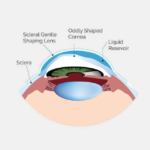
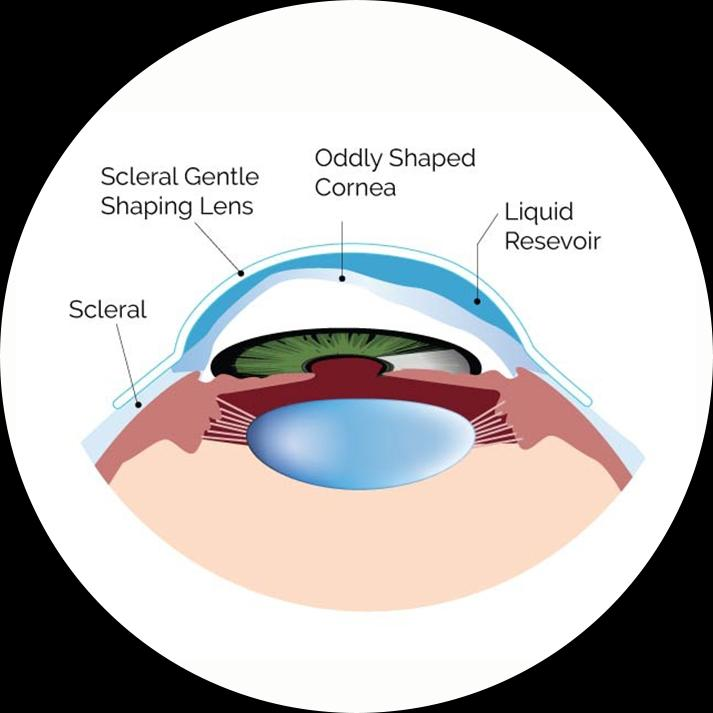
Scleral lenses are large-diameter, rigid gas permeable (RGP) lenses that
vault completely over the cornea and rest on the sclera. Unlike corneal
RGP lenses, scleral lenses do not touch the corneal surface directly.
Their key design features include:
– Large diameter (typically 14.5 mm to 20 mm or more)
– Complete corneal vaulting
– Fluid reservoir between the lens and cornea
– High oxygen permeability
The most important concept behind scleral lenses is the creation of a fluid-
filled optical surface. Before insertion, the lens is filled with sterile saline
solution. Once applied, this saline layer masks the corneal irregularities by
forming a smooth refractive surface.
As a result, incoming light passes through a regular optical interface,
significantly improving visual clarity.
Mechanism of Visual Improvement-
The primary mechanism by which scleral lenses improve vision in irregular
corneas is optical neutralization.
1. The lens vaults over the irregular cornea.
2. The saline reservoir fills the uneven spaces.
3. A new smooth anterior refractive surface is created.
This eliminates much of the irregular astigmatism and reduces higher-order
aberrations.
In keratoconus, for example, where the cornea becomes conical and steep,
scleral lenses provide:
1. Stable and centered optics
2. Reduced distortion
3. Improved contrast sensitivity
4. More predictable visual performance
Unlike small RGP lenses, scleral lenses are more stable and less likely to
decenter, which is particularly important in advanced ectasia.
Clinical Indications-
Scleral lenses are indicated in various irregular corneal conditions. Some of
the most common include:
1. Keratoconus and Ectatic Disorders-
Scleral lenses are now considered one of the gold standards in visual
rehabilitation for moderate to advanced keratoconus. They provide superior
comfort compared to corneal RGP lenses and often delay or eliminate the
need for corneal transplantation.
2. Post-Surgical Corneas-
Patients with post-LASIK ectasia or irregular astigmatism after refractive
surgery benefit significantly from scleral lenses. They help restore
functional vision when spectacles fail.
3. Post-Keratoplasty-
After corneal transplantation, surface irregularity is common. Scleral lenses
provide optical rehabilitation while minimizing mechanical interaction with
the graft.
4. Corneal Scarring-
In cases of trauma or infection leading to irregular scarring, scleral lenses
can mask the irregular surface and improve visual outcomes.
5. Severe Ocular Surface Disease-
Beyond optics, scleral lenses also serve a therapeutic role. The fluid
reservoir continuously bathes the cornea, providing relief in severe dry eye,
Stevens-Johnson syndrome, and graft-versus-host disease.
Fitting Considerations –
Fitting scleral lenses requires careful assessment and expertise. It is not a
simple trial-and-error process.
Key parameters include:
– Sagittal depth
– Corneal clearance
– Limbal clearance
– Landing zone alignment
– Edge alignment
Anterior segment OCT has become an essential tool in modern scleral lens
fitting. It helps evaluate corneal clearance and ensures there is no
excessive bearing or compression on conjunctival vessels.
Initial central clearance typically ranges between 200–400 microns after
settling. Excessive clearance may reduce oxygen transmission, while
insufficient clearance risks corneal touch.
Another important aspect is tear exchange. Although minimal in scleral
lenses, ensuring appropriate fit reduces hypoxic stress and midday fogging.
Advantages Over Other Modalities-
Compared to corneal RGP lenses, scleral lenses offer:
– Better initial comfort
– Greater stability
– Reduced lens awareness
– Less risk of corneal abrasion
Compared to hybrid lenses:
– More customizable parameters
– Better vaulting in highly irregular corneas
– Greater therapeutic benefits
From a patient perspective, the improvement in quality of life is often
remarkable. Many patients who were previously unable to drive at night or
work comfortably regain functional indLimitations
Challenges and Limitations-
Despite their advantages, scleral lenses are not without challenges:
– Higher cost
– Longer chair time
– Learning curve for insertion and removal
– Risk of hypoxia if poorly fitted
– Midday fogging in some patients
Proper patient education is essential. Patients must be trained on hygiene,
saline filling technique, and regular follow-up schedules.
CIntroduction –
Scleral lenses have revolutionized the management of irregular corneas.
They provide not only superior optical correction but also therapeutic
benefits in compromised ocular surfaces. In many cases, they restore
visual function where conventional modalities fail.
As clinicians, adopting scleral lens technology requires commitment, skill
development, and patient-centered care. However, the outcomes justify the
effort. For patients with irregular corneas, scleral lenses are often more
than just contact lenses—they are a gateway to restored vision and
improved quality of life.
In modern optometric practice, scleral lenses are no longer a niche option;
they are an essential tool in advanced corneal management.