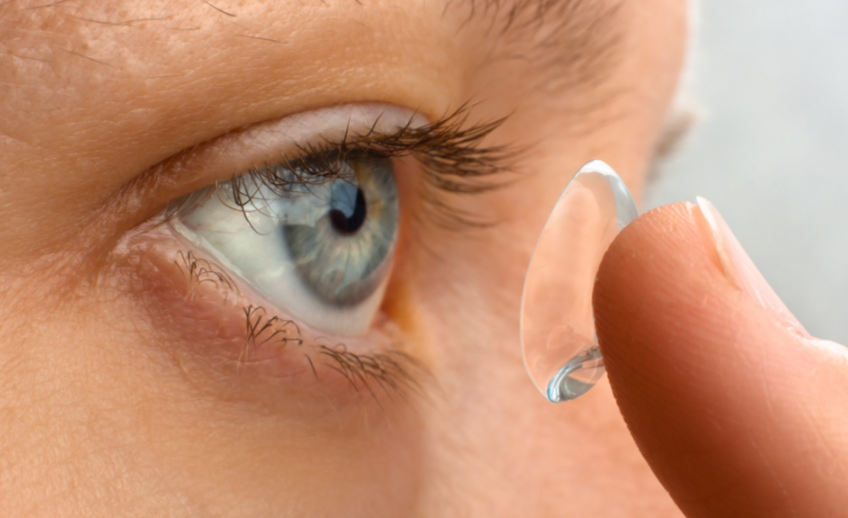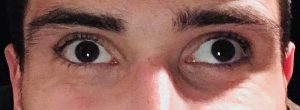
Cosmetic contact lenses, also referred as decorative, coloured, or plano lenses, are soft contact
lenses designed primarily to alter the appearance of the eye rather than to correct refractive error,
though many are available in prescription powers as well. They come in dozens of shades; violet,
honey, electric blue, smoky grey. They can make brown eyes green, turn hazel eyes silver, or give
you the dramatic look of a character straight out of a manga.
They can be broadly divided into two categories: tinted lenses, which subtly enhance the natural
eye colour, and opaque lenses, which completely mask the iris to create a dramatic colour change.
A third, growing category includes special-effect or theatrical lenses (cat eyes, zombie pupils, full-
black scleral designs) used in cosplay, film, and Halloween contexts. All of these, whether sold at
a pharmacy, beauty supply store, or online retailer, are classified as medical devices by regulatory
authorities including the U.S. Food and Drug Administration (FDA) and the Therapeutic Goods
Administration (TGA) in Australia. This classification exists for a reason: every contact lens,
regardless of whether it carries a corrective power, interacts directly with the living tissue of the
cornea and conjunctiva.
But behind the glamour lies a medical reality that far too many wearers discover only after
something has gone wrong: cosmetic contact lenses are not fashion accessories. They are
medical devices, and when misused, they can cause permanent, irreversible damage to your
vision.
Risks of Improper Use
The risks associated with cosmetic contact lens misuse are not theoretical, they are well
documented in literature. The harms range from temporary discomfort to permanent blindness,
and they arise most frequently when lenses are obtained without a prescription, worn without
professional fitting, shared between wearers, or cared for inadequately. Below are four of the most
clinically significant risks.
1. Microbial Keratitis: (The Infection That Can Blind)
Microbial keratitis (MK) is a corneal infection involving bacteria, fungi, protozoa, or viruses, and it
represents the most feared complication of contact lens wear. Left untreated or treated too late, it
can result in corneal scarring, perforation, and permanent loss of vision. Population-level data
reinforce these concerns. It is estimated that nearly one in 500 contact lens wearers per year will
develop MK with overnight use, with the highest rates observed among overnight soft lens wearers
— between 9.2 and 20.9 per 10,000 users. Among the pathogens most commonly implicated is
Pseudomonas aeruginosa, but perhaps the most devastating is Acanthamoeba, a free-living
protozoan found in tap water, swimming pools, and poorly cleaned lens cases, which can produce
a chronic, excruciatingly painful keratitis that is notoriously resistant to treatment.
2. Corneal Hypoxia
Unlike the rest of the body, the cornea has no blood vessels. It depends almost entirely on the
atmosphere for its oxygen supply. When a contact lens sits on the corneal surface, it acts as a
partial barrier to this atmospheric oxygen and when that lens is thick, poorly fitted, or worn for
excessive hours, the consequences can be serious.
If the cornea's atmospheric oxygen supply drops below approximately 74 mmHg, as frequently
occurs during contact lens wear, the cornea becomes hypoxic and its epithelial cells begin to
respire anaerobically. The corneal stroma then becomes oedematous, it swells and oedema of
sufficient magnitude causes the cornea to become cloudy, ultimately threatening the tissue's
transparency.
3. Allergic Reactions and Giant Papillary Conjunctivitis
Non-infectious reactions to cosmetic contact lenses are primarily driven by the eye’s immune
response to foreign materials. The most prevalent condition is Giant Papillary Conjunctivitis
(GPC), which involves inflammation of the inner upper eyelid.
The development of GPC is attributed to four key factors:
Mechanical trauma: Friction from the lens edge against the palpebral conjunctiva.
Hypoxia: Reduced oxygen supply to the eyelid tissues.
Chemical irritation: Reactions to preservatives (like thimerosal) in cleaning solutions.
Immune response: Hypersensitivity to protein deposits accumulated on the lens surface.
Symptoms include itching, cobblestone; papillae, mucus discharge, and decreased lens comfort.
4. Vision Impairment and Blindness
Misuse of cosmetic contact lenses carries a high risk of permanent vision loss or blindness, a
clinical reality documented in peer-reviewed case reports. These reports highlight instances where
lenses purchased from unauthorized vendors caused severe infections, with some cases requiring
corneal transplantation.
Safe Usage Guidelines
Guideline 1: Professional Consultation, Proper Fitting, and Prescription
Safe contact lens wear is a medical necessity, not a cosmetic choice. Because lenses are
classified as medical devices, federal law(in US) requires a professional prescription for all
types—including decorative ones.
The Clinical Foundation
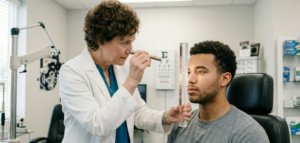
Professional Fitting: An optometrist uses diagnostic tools like corneal topography to
measure your eye's unique shape. A lens with the wrong base curve or diameter can
cause physical trauma or starve the eye of oxygen.
Supervised Training: In-clinic sessions ensure you can insert and remove lenses without
causing corneal abrasions.
Avoiding "Over-the-Counter" Risks
Never purchase lenses from unauthorized retailers like costume shops or flea markets. These
unregulated products are often:
1. Illegal and unvetted by health authorities.
2. Contaminated with bacteria.
3. Counterfeit, using sub-standard materials.
Long-term Care
Regular follow-ups and annual exams are vital. They allow practitioners to use slit-lamp
biomicroscopy to detect silent issues like microscopic inflammation or new blood vessel growth
before they lead to permanent vision loss.
Guideline 2: Strict Hygiene Practices and Proper Lens Care Solutions
Strict hygiene is the primary defense against microbial keratitis, a sight-threatening infection.
Research shows that full compliance is rare, but following these protocols can eliminate up to
99.9% of bacterial risks.
1. The Rub and Rinse Method
Mechanical cleaning is mandatory for all reusable lenses. Chemical soaking alone cannot
penetrate bacterial biofilms.
The Process: Place the lens in your palm with approved solution and rub it gently with your
finger. This friction physically disrupts protein deposits and lipids that harbor pathogens.
Hand Hygiene: Always wash hands with antibacterial soap and dry them with a lint-free towel before touching your eyes or lenses.
2. Case Maintenance
The lens case is often the most contaminated item in the regimen.
No Topping Off ;: Never add new solution to old. Empty the case daily, rub it with fresh solution, and wipe it dry.
Air Dry: Leave the case face down to dry completely; moisture encourages the growth of amoebas.
Replacement: Discard and replace your lens case every three months.
3. The Danger of Water
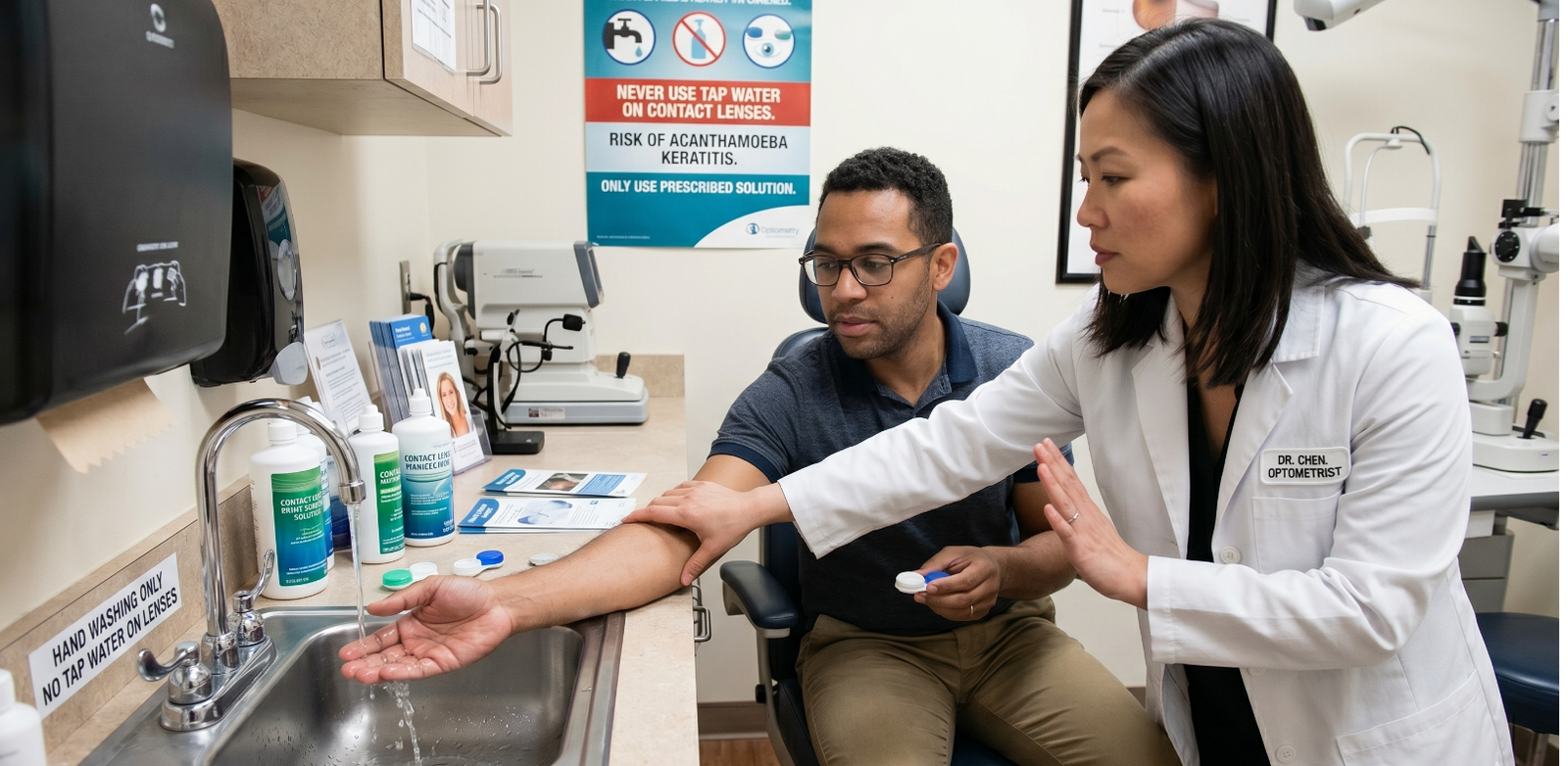
Water exposure is the most significant avoidable risk for lens wearers. Tap water, pools, and
showers harbor Acanthamoeba, a parasite that can cause permanent blindness.
Risk Factor: Showering while wearing lenses increases your risk of infection by 3 to 7 times.
Rule of Thumb: Only sterile, FDA-approved solutions should ever touch your lenses or
case. Keep them away from all non-sterile water sources.
Guideline 3: Adherence to Wearing Schedule and Replacement Frequency
The cornea’s health depends on consistent rest and access to oxygen. Violating prescribed
wearing schedules creates a perfect storm for rapid vision loss.
1. The Dangers of Overnight Wear
Unless specifically prescribed for extended wear, lenses must be removed before sleep.
Hypoxic Stress: Sleeping in lenses starves the cornea of oxygen.
The Microenvironment: Eyelid closure stops the "tear pump" that flushes out debris. This
traps bacteria, stagnant tears, and dead cells against the eye, leading to rapid infectious
ulceration and corneal edema.
2. Adhering to Replacement Modalities
Lenses are engineered for specific life cycles (daily, bi-weekly, or monthly). Using them longer than
intended causes:
Bio-fouling: Irreversible buildup of proteins and lipids.
Reduced Permeability: These deposits act as a barrier to oxygen and a breeding ground
for microbes.
Mechanical Friction: Aged lenses become rough, causing microscopic trauma to the ocular surface.
3. Critical Safety Rules
No Sharing: Never swap lenses. This facilitates the immediate transmission of viruses and
aggressive pathogens between individuals.
The "When in Doubt" Rule: If you experience redness, pain, light sensitivity, or discharge,
remove the lenses immediately and seek urgent clinical care.
While cosmetic contact lenses are popular for aesthetic transformation, they are invasive
medical devices that require the same clinical rigor as corrective lenses to prevent irreversible
vision loss. Federal law mandates that all lenses be fitted and prescribed by a licensed eye
care professional to ensure proper corneal oxygenation and anatomical alignment, as
unregulated "over-the-counter" products often harbor virulent pathogens like Acanthamoeba.
Maintaining ocular health requires unwavering adherence to hygiene protocols, specifically the
mechanical "rub and rinse" method with sterile solutions and the strict avoidance of water
exposure, sharing lenses, or sleeping in daily-wear modalities. Ultimately, preventing sight-
threatening complications like microbial keratitis and corneal scarring depends on prioritizing
physiological safety and professional medical supervision over superficial aesthetic appeal.
Refrences:
1. Efron, N. (2018). Contact lens practice (3rd ed.). Elsevier.
2. Holden, B. A., & Mertz, G. W. (1984). Critical oxygen levels to avoid corneal oedema for
daily and extended wear contact lenses. Investigative Ophthalmology & Visual Science,
25(10), 1161–1167.
3. Donshik, P. C. (2003). "Giant papillary conjunctivitis." Current Opinion in Allergy and Clinical
Immunology, 3(5), 387-391.
4. Steinemann, T. L., Pinninti, U., Szczotka, L. B., Eiferman, R. A., & Price, F. W. (2003).
Ocular complications associated with the use of cosmetic contact lenses from unlicensed
vendors. Eye & Contact Lens, 29(4), 196–200.