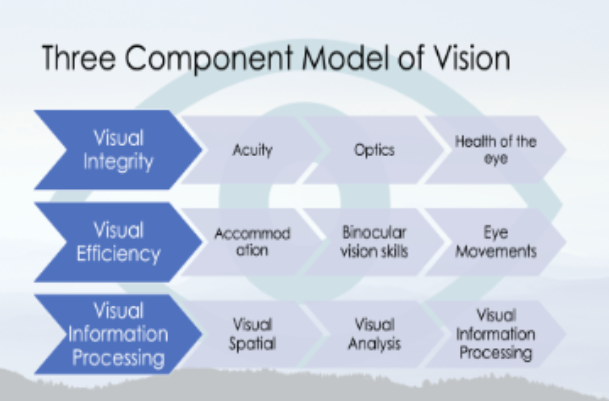
Most people think good vision simply means passing an eye chart test. If you can read the small letters at the bottom, your eyes must be fine. But vision is not a single skill. It is a complex process that involves the eyes, the brain, and the many connections between them. The Three Component Model of Vision breaks this process into three layers: visual integrity, visual efficiency, and visual information processing. Understanding these layers helps explain why someone can have perfect 20/20 eyesight and still struggle to read, learn, or feel comfortable using their eyes for long periods.
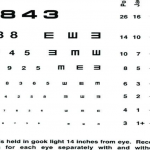
The first component is visual integrity. This is the part most people already know. It includes how sharp your eyesight is, whether you are nearsighted, farsighted, or have astigmatism, and whether the eyes themselves are healthy. In other words, visual integrity is about the physical hardware of the eye. It is like the camera lens and sensor on a phone. If the lens is scratched or the sensor is damaged, the picture will not be clear. Eye doctors check this layer with tests like the standard letter chart, refraction, and eye health exams. Corrective lenses, medicine, or surgery often help when this layer is weak. But visual integrity is only the beginning. A clear image entering the eye does not guarantee that the brain can use that image easily.
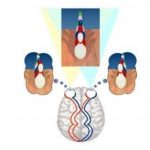
The second component is visual efficiency. This layer describes how well the two eyes work together and how smoothly they move and focus. It has three main parts: accommodation, binocular coordination, and eye movements. Accommodation is the eye’s ability to change focus from far to near and back again, like a camera’s autofocus. Binocular coordination is the teamwork of both eyes aiming at the same target and sending one combined image to the brain. Eye movements are the tiny, rapid jumps we use when reading, scanning a room, or following a moving ball. When visual efficiency is poor, a person may see 20/20 on the chart but still experience eyestrain, headaches, double vision, skipped words, or loss of place while reading. This is not a matter of laziness. The eyes are simply working too hard to maintain clear, comfortable vision.
The third component is visual information processing. This is the brain’s role in vision. After the eyes take in light, the brain must recognize, organize, remember, and act on what is seen. This layer includes visual discrimination, which is telling the difference between similar shapes or letters, such as b and d. It includes visual memory, which helps you recall what you have seen. It includes visual spatial relations, which help you judge distance, direction, and where objects are in space. It also includes visual-motor integration, which allows you to copy from a board, catch a ball, or write neatly. A person with visual information processing problems may have healthy eyes and efficient eye movements, yet still struggle with reading comprehension, math, puzzles, maps, or sports. The eyes are sending information, but the brain is not interpreting it quickly or accurately enough.
These three components do not operate in isolation. They build on one another and affect one another. Visual integrity provides the raw input. Visual efficiency keeps that input stable, comfortable, and coordinated. Visual information processing gives the input meaning and turns it into action. If the first layer is weak, the other two may suffer. If the second layer is strained, attention and processing can slow down. If the third layer is underdeveloped, even perfect eyesight may not lead to easy learning. This is why a complete vision evaluation should look beyond the letter chart. It should ask not only “Can you see it?” but also “How comfortably, how efficiently, and how well does your brain understand it?”
For parents, teachers, and adults, the model offers a helpful lens. A child who rubs their eyes, avoids reading, or complains of headaches may not need stronger glasses alone. An adult who feels drained after computer work may need more than a new prescription. A student who reads slowly despite good eyesight may need a visual processing assessment. The Three Component Model does not replace regular eye exams. Instead, it expands them. It reminds us that vision is a partnership between the eyes and the brain, and that clear sight is only one part of seeing well.
If you or someone you love struggles with visual tasks, do not assume the problem is imaginary or that nothing can be done. Ask for a functional vision evaluation that checks all three components. With the right support, visual efficiency can be trained, processing skills can be strengthened, and the eyes and brain can learn to work together more smoothly. Seeing well is not just about the size of the letters you can read. It is about how comfortably, efficiently, and meaningfully you can use your vision in daily life. That shift in understanding can change lives. It can open doors to daily learning, confidence, and independence. Everyone truly deserves to see the world comfortably.