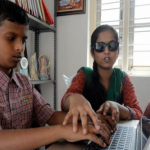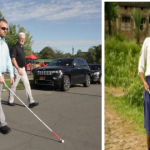
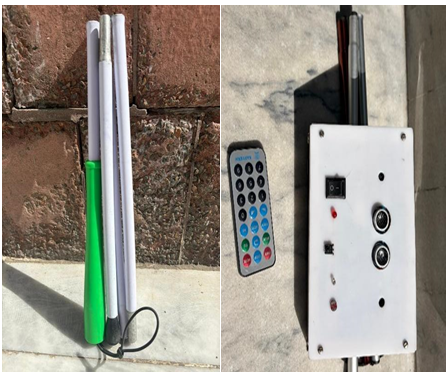
Figure: Traditional White Cane and AFIUMA Cane (Edition 1.0), a sensor-based smart mobility cane equipped with obstacle detection sensors and a remote control system without wireless connectivity.
Vision is one of the most important senses that help individuals understand and interact with the world. However, for people living with visual impairment daily activities such as walking independently, crossing roads, navigating unfamiliar environments and participating in social activities can become challenging. Vision rehabilitation focuses not only on managing visual impairment but also on maximizing functional abilities and improving quality of life. Among the most recognized and effective mobility tools used in rehabilitation is the white cane—a simple yet powerful device that represents independence, confidence and freedom of movement. The internationally recognized symbol of blindness commonly represents a person walking with a white cane.
The White Cane: A Tool for Independence
The white cane is one of the most important mobility devices used by individuals with visual impairment. It acts as an extension of the user’s senses, allowing them to detect obstacles, recognize changes in the walking surface and make safe decisions while traveling. The primary purpose of the white cane is not only obstacle avoidance but also enabling individuals to travel independently with confidence and dignity.
Importance of Orientation and Mobility Training
Although the white cane is an effective mobility tool, proper training is essential for safe and efficient use. Orientation and Mobility specialists teach individuals how to use the cane confidently and effectively.
Training includes:
With appropriate training, individuals with visual impairment can travel independently in educational institutions, workplaces, markets and community settings. The white cane does not replace vision completely; instead, it works together with residual vision, hearing, touch, memory and other sensory information to support safe mobility.
Role of Optometrists in Mobility Rehabilitation
Optometrists play a vital role in the early identification and management of individuals who experience functional difficulties due to visual impairment. Beyond assessing visual acuity and prescribing optical corrections, optometrists should consider how vision loss affects a patient’s ability to perform daily activities, navigate environments and maintain independence.
Patients with significant visual challenges may benefit from referral to low vision rehabilitation services and Orientation and Mobility training. Through timely referral and a multidisciplinary approach, optometrists can help individuals develop effective coping strategies, improve mobility skills and achieve greater confidence and independence in their everyday lives.
AFIUMA: A Student Innovation in Smart Mobility Assistance
Technology is creating new opportunities to enhance mobility and safety for individuals with visual impairment. As a final-year project, optometry students developed an innovative smart cane named AFIUMA under the supervision of Maryam Jabbar, Lecturer, Department of Optometry, The University of Faisalabad, Pakistan.
The project team included Fatima Imran, Mishal Imtiaz, Urba Tahir, Irsa Saleem, and Arwa Asif. The name AFIUMA is inspired by the Arabic words “Afia” and “Ummah.” Afia represents well-being, wellness and protection, while Ummah represents community and collective support.
AFIUMA was developed in two editions, combining traditional mobility assistance with modern sensor and communication technologies. AFIUMA Edition 1.0 was a sensor-based smart cane designed to provide additional support during mobility. Unlike the traditional white cane, which detects obstacles through physical contact and tactile feedback, AFIUMA Edition 1.0 incorporates sensor-based obstacle detection technology that can identify obstacles before physical contact occurs. Building on this concept, AFIUMA Edition 2.0 introduced Wi-Fi connectivity and advanced safety features, transforming the smart cane into a more comprehensive assistive device with enhanced communication and emergency support capabilities.
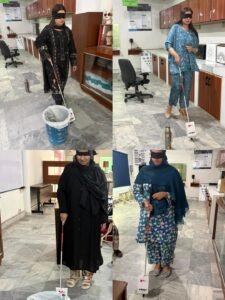
Figure: Glimpses of data collection and navigation assessment using the Wi-Fi-enabled AFIUMA smart cane among blindfolded participants.
AFIUMA demonstrates how optometry students can combine clinical understanding with technology to develop innovative solutions that complement traditional Orientation and Mobility training and improve safety, independence and quality of life.
Watch the AFIUMA Smart Cane Demonstration Video: https://www.facebook.com/share/v/1BXhoDU3R7/?mibextid=wwXIfr