We have all heard the phrase “work-life balance”. Usually, it brings to mind images of leaving
the office on time, having dinner with family, or finally finding a moment to read a book. We
think of it as a mental health issue, about reducing stress or preventing burnout. But what if I
told you that your blurred vision, your afternoon headaches, and that gritty, tired feeling in
your eyes are not just medical problems. They are often the first physical warning signs that
your work-life balance is broken.
In the modern world, the line between the office and home has vanished. For millions of
people, the laptop that sits on a desk at 10:00 AM is the same laptop that sits on the coffee
table at 10:00 PM. Because we carry our work in our pockets and on our laps, our eyes never
get the signal that the workday is over. Understanding the connection between how you live
your life and how your eyes feel is the first step to protecting your vision for a long time.
The Invisible Muscle at Work
To understand why balance matters, you first have to understand what your eyes actually go
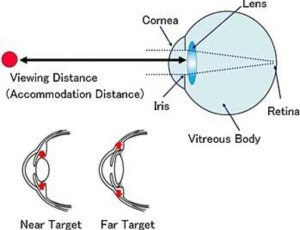
through during a workday. Think of the focusing system inside your eye as a rubber band. When
you look at something far away, like a mountain or a tree across the street, that rubber band is
relaxed. It requires almost no effort. However, when you look at something close up,
specifically a screen that is 12 to 20 inches from your face, that rubber band has to flex and
tighten. It has to contract with force to bend light so you can see pixels clearly.
Now, imagine holding a heavy weight with your arm flexed. You can do it for a minute. You can
even do it for an hour. But try doing it for nine or ten hours straight, without putting the weight
down. Your arm would scream in pain. That is exactly what we are doing to the tiny muscles
inside our eyes. The medical term for this strain is Computer Vision Syndrome, or Digital Eye
Strain. It happens because the muscles that control focus (the ciliary muscles) get stuck in a
permanent state of flex.
When we have poor work-life balance, we aren't giving those muscles a break. If you work from
9 to 5, then scroll social media until 7, then watch a movie on a tablet until 10, your eyes have
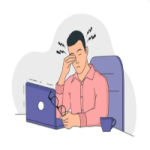
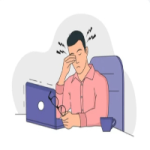
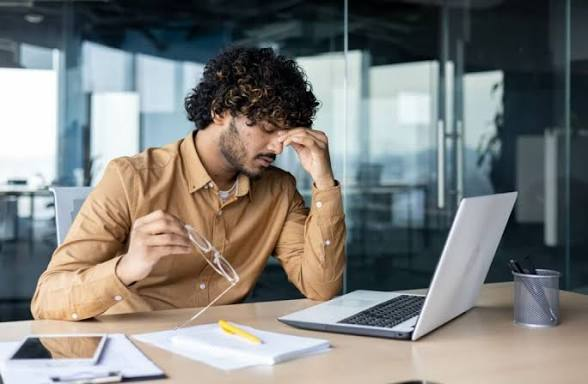
been flexing that muscle for nearly 13 hours straight. The result? Headaches, blurred distance
vision, difficulty concentrating, and a burning sensation in the eyes.
The Second Shift of Screen Time
Here is where the concept of work-life balance becomes critical. Even if you leave your physical
office, the "screen shift" continues. We have developed a habit of treating non-work hours as
"relaxation," but for our eyes, a phone screen is not relaxation.
Let’s look at the math. A healthy worker blinks about 15 to 20 times per minute. Blinking is
essential because it spreads a film of tears across the eye, washing away dust and keeping the
surface smooth. When you are "in the zone" on a work project, you don't blink. When you are
"relaxing" by binge-watching a series, you blink just as rarely.
So, if you work an 8-hour day and then spend 4 hours of leisure time on screens, your eyes go
through 12 hours of low-blink, high-focus torture. That dry, scratchy feeling you get at 9:00 PM
isn't just tiredness; it is inflammation caused by a lack of lubrication. You aren't balancing your
life; you are just moving the strain from one app to another.
The Glare of After-Hours Anxiety
There is also a psychological component that physically manifests in the eyes. Poor work-life
balance usually involves "context switching", quickly jumping between a work email and a
family text message. Every time you receive a message at 8:00 PM while you are trying to cook
dinner, your pupils undergo a stress response. When you are stressed or anxious, your body
releases cortisol and adrenaline. These chemicals change the way your eyes function. They can
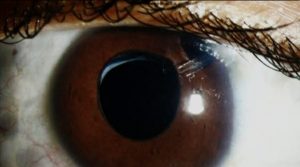
cause your pupils to dilate slightly, which lets in more light but makes it harder to focus sharply
on fine print. Worse, stress can reduce blood flow to the eyes and increase intraocular
pressure. That throbbing sensation behind your eye after a late-night work session? That is your
visual system crying out for a boundary.
When we fail to unplug, when we turn off notifications but keep the screen in our hands, we
keep our nervous system in a state of low-grade fight-or-flight. Over months and years, this
chronic stress can worsen underlying eye conditions, accelerate retinal deterioration, and lead
to persistent dry eye disease that requires prescription and medications to manage.
Blue Light, Melatonin, and the Vicious Cycle
Another major player in the eye-strain-balance equation is sleep. To have healthy eyes, you
need good sleep. While you sleep, your eyes are repaired. Fluids circulate, inflammation
decreases, and the "rubber band" muscles finally get to fully relax. However, poor work-life
balance destroys sleep quality through blue light.
Screens emit high-energy visible (HEV) blue light. Your brain interprets blue light as sunlight.
When you work late, or even when you scroll through your phone in bed, your retina sends a
signal to your brain: "It is still daytime. Do not make melatonin." Melatonin is the hormone that
makes you feel sleepy. Without it, you lie awake staring at the ceiling.
Now you enter a vicious cycle. You are tired because your eyes kept you awake. But because
you are tired, your eyes are even more strained the next day. Fatigue reduces muscle control,
meaning your eyes have to work twice as hard to focus on the same screen. You end up
squinting, leaning closer, and making the strain worse. Before long, you are buying reading
glasses or suffering from migraines, wondering why your body is falling apart when you are
"just working."
Physical Posture Equals Eye Health
We cannot talk about eye strain without looking at your neck and shoulders. Work-life balance
isn't just about time; it's about ergonomics. When you are rushing to finish a task on the couch,
or hunching over a kitchen counter, your viewing angle is terrible. Most casual environments
cause you to look down at the screen at a sharp angle, or tilt your head back.
This posture messes with your binocular vision, the ability of both eyes to work together as a
team. When your head is tilted, your eye muscles have to twist slightly to keep the image level.
Over an hour, that twisting causes fatigue. Over a day, it causes strain headaches that start at
the base of the skull and wrap around to the forehead. Proper work-life balance requires a
designated "off-work" posture. If you are sitting the same way to watch a movie as you did to
write a report, your eyes never get a postural break.
The Social Media Deception
One of the biggest hurdles to fixing this problem is the deception of "passive scrolling." Many
people defend their screen time by saying, "I'm just relaxing, I'm not really working." But for
your eyes, the intensity of the activity matters less than the distance and the duration.
Relaxing is not an activity; it is a physiological state. True relaxation for the eyes involves
looking at a variety of distances. It involves walking outside, looking at the horizon, or simply
closing your lids. When you scroll social media, your eyes are darting rapidly (saccade),
refocusing on different sizes of text, videos, and images. This is not rest. This is micro-exercise.
If you ran on a treadmill for 8 hours at work, then went home and ran on a treadmill for 4 more
hours "for fun," you would destroy your knees. Scrolling is the treadmill for your eyes.
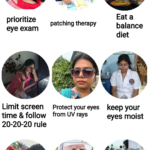
Practical Strategies for Management.
20-20-20 Rule.
Screen-Free Zone
Use of artificial tears
Posture and Lighting Adjustments.