Introduction
Irregular corneal conditions can significantly affect a person’s quality of life. Patients
with distorted corneal surfaces often struggle with blurred vision, glare, halos, poor
night vision, and discomfort. For many years, treatment options were limited, and
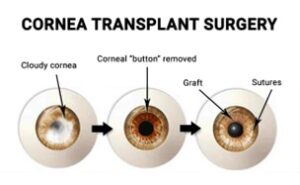
some individuals eventually required corneal transplantation to achieve functional
vision. However, the development and advancement of scleral lenses have
transformed the management of irregular corneas.
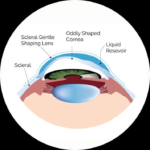
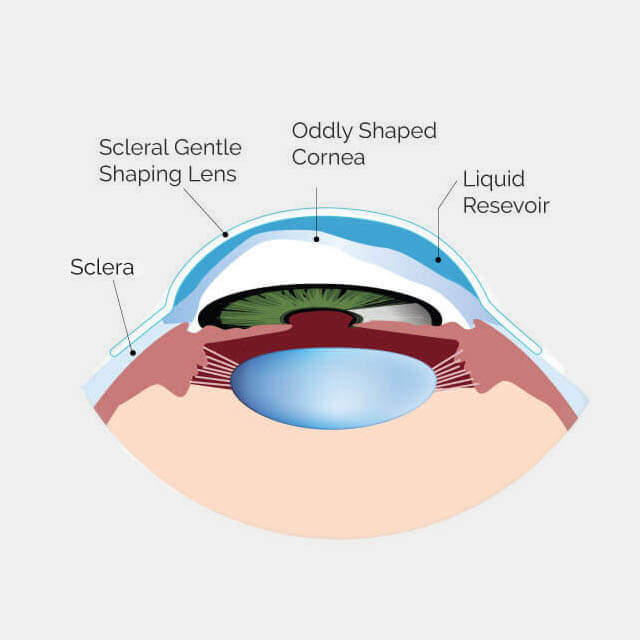
Scleral lenses are large-diameter rigid gas permeable contact lenses that rest on the
sclera while completely vaulting over the cornea. A fluid-filled reservoir remains
between the lens and the cornea, creating a smooth optical surface and improving
both comfort and visual quality. Today, scleral lenses are widely recognized as one
of the most successful non-surgical treatment options for complex corneal diseases.
Modern advances in lens materials, digital imaging, lens customization, fitting
techniques, and surface coatings have dramatically improved patient outcomes.
These innovations allow practitioners to provide clearer vision, greater comfort, and
healthier long-term corneal management for patients with irregular corneas.
Understanding Irregular Corneas
The cornea is the transparent front surface of the eye that helps focus light onto the
retina. In a healthy eye, the cornea has a smooth and regular curvature. However, in
certain diseases or after surgical procedures, the cornea may become distorted or
uneven. This condition is known as an irregular cornea.
Common causes of irregular corneas include keratoconus, pellucid marginal
degeneration, post-LASIK ectasia, corneal scars, trauma, infections, and
complications following corneal transplantation. These conditions distort the way
light enters the eye, resulting in poor visual quality that cannot always be corrected
with standard eyeglasses or soft contact lenses.
Patients often experience fluctuating vision, glare, halos around lights, ghost images,
and difficulty driving at night. In severe cases, visual impairment can interfere with
work, education, and daily activities. Because traditional contact lenses conform to
the shape of the irregular cornea, they may fail to provide stable and clear vision.
Scleral lenses solve this problem by masking the irregular surface with a smooth
refractive layer.
History and Evolution of Scleral Lenses
The concept of scleral lenses is not entirely new. Early versions of scleral lenses
were developed in the late nineteenth century using glass materials. Although they
improved vision in some patients, they were uncomfortable and prevented oxygen
from reaching the eye.
Over time, advancements in lens technology led to the development of plastic and
gas permeable materials. These newer materials allowed oxygen transmission and
significantly improved safety and comfort. Modern scleral lenses are now
lightweight, highly breathable, and customizable.
The rise of digital imaging and advanced manufacturing techniques has further
transformed scleral lens practice. Practitioners can now design highly individualized
lenses based on precise measurements of the eye. This evolution has made scleral
lenses more accessible and successful for patients with complex corneal conditions.
How Scleral Lenses Work
Unlike traditional contact lenses that rest directly on the cornea, scleral lenses vault
over the entire corneal surface and land on the sclera. Before insertion, the lens is
filled with sterile saline solution. Once applied to the eye, this fluid reservoir
remains trapped beneath the lens.
The fluid layer neutralizes corneal irregularities and creates a smooth optical
surface. As a result, light entering the eye is focused more accurately, improving
visual clarity. Because the lens does not touch the sensitive corneal surface, many
patients experience excellent comfort even if they could not tolerate smaller rigid
gas permeable lenses.
The fluid reservoir also protects and hydrates the ocular surface, making scleral
lenses valuable not only for visual rehabilitation but also for therapeutic
management of ocular surface disease.
Advances in Lens Materials
One of the most important developments in scleral lens technology has been the
improvement of lens materials. Modern scleral lenses are manufactured using
highly oxygen-permeable gas permeable materials. These materials allow oxygen to
pass through the lens and reach the cornea, reducing the risk of hypoxia-related
complications.
Earlier contact lens materials often caused corneal swelling, redness, and discomfort
after prolonged wear. Today’s high-Dk materials provide better corneal health and
allow longer wearing times.
Manufacturers have also improved the durability and wettability of lens materials.
Better wettability reduces dryness and improves comfort throughout the day. In
addition, newer materials resist protein and lipid deposits more effectively, making
cleaning and maintenance easier for patients.
Digital Customization and Imaging
Advanced imaging technology has revolutionized scleral lens fitting. Corneal
topography, tomography, and anterior segment optical coherence tomography
provide highly detailed images of the eye’s surface.
These technologies allow practitioners to evaluate corneal shape, scleral curvature,
and lens clearance with remarkable precision. Modern software can use these
measurements to design highly customized lenses for individual patients.
Some patients have asymmetrical scleral shapes that require quadrant-specific or
toric scleral designs. Digital customization improves lens alignment, stability, and
comfort while reducing fitting complications.
This level of precision was difficult to achieve in earlier years, when practitioners
relied mainly on trial lenses and clinical observation.
Wavefront-Guided Optics
Even after correcting the irregular corneal surface, some patients continue to
experience reduced visual quality because of higher-order aberrations. These
optical imperfections can affect contrast sensitivity, night vision, and image
sharpness.
Wavefront-guided scleral lens technology addresses this issue by measuring these
aberrations and incorporating customized optical corrections directly into the lens
design.
This technology has shown promising results in patients with advanced keratoconus
and post-surgical ectasia. Benefits may include sharper vision, reduced glare,
improved contrast sensitivity, and better night driving performance.
Although wavefront-guided technology is still evolving, it represents an exciting
direction for future scleral lens innovation.
Therapeutic Applications
Scleral lenses are increasingly used not only for vision correction but also for
therapeutic purposes. The fluid reservoir beneath the lens continuously hydrates
the ocular surface and protects it from environmental exposure.
Patients with severe dry eye disease, Sjögren syndrome, graft-versus-host disease,
Stevens-Johnson syndrome, and neurotrophic keratitis may benefit greatly from
scleral lenses.
In these cases, the lenses act almost like a protective bandage for the eye. Many
patients report significant improvement in comfort, reduced pain, and better visual
stability after starting scleral lens wear.
This therapeutic role has expanded the importance of scleral lenses in both
optometry and ophthalmology.
Modern Fitting Techniques
Fitting scleral lenses used to be difficult and time-consuming. Patients often
required multiple visits and several lens modifications before achieving a successful
fit.
Modern fitting techniques have improved dramatically with the help of advanced
imaging systems and software-guided analysis. Practitioners can now evaluate
corneal clearance, limbal clearance, and scleral alignment more accurately.
Anterior segment OCT allows clinicians to assess the lens fit in cross-sectional detail.
This reduces fitting complications such as conjunctival blanching, excessive vault,
air bubbles, and lens decentration.
Improved fitting strategies have increased patient satisfaction and reduced chair
time in clinical practice.
Benefits for Patients
The benefits of scleral lenses for irregular corneas are substantial. Many patients
experience dramatic improvements in visual acuity and quality of life.
Because scleral lenses create a stable optical surface, vision tends to remain more
consistent throughout the day compared to soft contact lenses. Patients often report
clearer night vision and reduced glare.
Comfort is another major advantage. Since the lenses rest on the sclera rather than
the cornea, many patients tolerate them better than traditional rigid lenses.
Scleral lenses may also delay or eliminate the need for corneal transplantation in
some patients with keratoconus or corneal ectasia. This can reduce surgical risks
and preserve corneal tissue.
Challenges and Limitations
Despite their advantages, scleral lenses still present some challenges. Cost remains a
significant barrier for many patients because these lenses are highly customized and
require specialized fitting.
Handling can also be difficult for beginners. Insertion and removal techniques
require training and practice. Some patients may initially feel anxious about
applying large lenses to their eyes.
Midday fogging is another common complaint. Debris and tear film components may
accumulate beneath the lens, causing blurred vision during the day.
Access to scleral lens services may also be limited in some regions due to lack of
equipment or trained practitioners.
Future Directions
The future of scleral lens technology appears promising. Researchers are exploring
smart scleral lenses capable of monitoring intraocular pressure, glucose levels, and
ocular health parameters.
Drug-delivery scleral lenses are another exciting area of development. These lenses
may allow controlled delivery of medications directly to the ocular surface over
extended periods.
Three-dimensional printing technology could also improve manufacturing precision
and reduce production costs in the future.
Artificial intelligence and machine learning may further enhance fitting accuracy by
analyzing corneal scans and predicting ideal lens parameters automatically.
As these innovations continue, scleral lenses are expected to become even more
effective, accessible, and comfortable for patients worldwide.
Conclusion
Advances in scleral lenses have transformed the management of irregular corneas.
Improved materials, digital customization, wavefront-guided optics, therapeutic
applications, and advanced fitting techniques have significantly improved patient
outcomes.
For individuals with keratoconus, corneal scars, post-surgical ectasia, or severe
ocular surface disease, scleral lenses provide more than vision correction. They offer
comfort, protection, stability, and improved quality of life.
As research and technology continue to evolve, scleral lenses will likely play an even
greater role in modern eye care. Their ability to combine visual rehabilitation with
therapeutic benefits makes them one of the most valuable innovations in specialty
contact lens practice today.