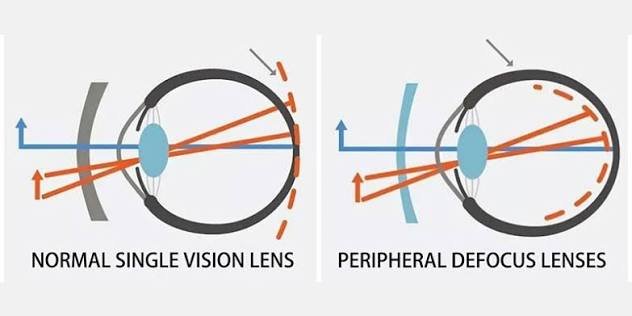
If your child has been diagnosed with myopia (nearsightedness), you have likely been told it is due to the eye growing too long. But why does the eye keep growing? The answer might lie not in what your child sees directly in front of them, but in what their eyes see at the edges. This is a concept called peripheral retinal defocus.
What Exactly is Peripheral Retinal Defocus?
Think of your eye like a camera. The retina is the film at the back. In a healthy eye, light focuses directly on the retina, giving clear vision . However, the eye is not a perfect sphere; its shape affects how light hits the edges of the retina.
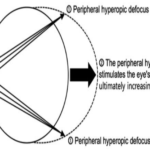
Peripheral defocus refers to where light focuses in the periphery (the outer part of your vision). When a child has myopia, the eye is too long. This means light focuses in front of the retina (myopic defocus). However, a key discovery in eye research is that the peripheral image often focuses behind the retina. This is known as hyperopic defocus.
The “Growth Signal” Problem
This is the crucial part; studies show that in hyperopic defocus, the image focusing behind the peripheral retina acts as a signal for the eye to grow longer. In a child’s developing eye, this signal tells the eyeball to elongate to “catch” the focus. As the eye elongates, the myopia worsens . In myopic eyes, the peripheral retina often receives this “grow longer” signal, creating a vicious cycle.
From Theory to Treatment: The New Lenses
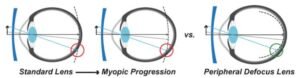
This is where “Peripheral Defocus” becomes a treatment. Researchers realized that if they could change the peripheral image to focus in front of the retina (myopic defocus), they could send a “stop growing” signal . This led to the creation of special spectacle lenses that look normal but have a hidden superpower.
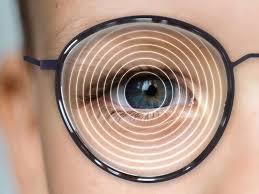
These lenses have a central area for clear vision but are engineered with tiny segments or lenslets that create myopic defocus in the periphery. They trick the eye into thinking it is slightly farsighted in the periphery, slowing down the elongation of the eyeball.
Do They Really Work? The Evidence
Recent studies show promise. One study comparing different lens designs found that highly aspherical lenslets were effective in reducing both the progression of myopia and axial length (eye growth) over a year. Another comparison found that specialized peripheral defocus spectacles helped inhibit axial elongation in children. These devices are now considered a crucial intervention for controlling myopia in children and adolescents.
New Insights: The Choroid and the “Sweet Spot”
The science is evolving. Researchers are using advanced tools like Multispectral Refractive Topography (MRT) to map these defocus patterns across the retina . It turns out that the “stop growing” signal might be most effective in specific regions of the retina, particularly the temporal and inferior regions, or the “retinal sweet spot” .
Furthermore, the response to these lenses is linked to the choroid, a vascular layer beneath the retina. Studies show that myopia control lenses cause the choroid to thicken, which is a good sign that the treatment is working by predicting future eye growth.
What Does This Mean for Your Child?
The days of simply getting stronger glasses every year are changing. For parents, this means there are proactive, science-backed options to slow down myopia progression. While older theories focused on contrast, the peripheral defocus theory has delivered tangible tools . Talk to your eye care professional about whether peripheral defocus lenses are a suitable option to help protect your child’s long-term vision.