Introduction
Low vision assessment is a systematic evaluation of a person who has permanent visual impairment that cannot be fully corrected by spectacles, contact lenses, medication, or surgery, but who can still use vision for daily activities. The main aim is to maximize the remaining (residual) vision and improve quality of life through proper rehabilitation.
Aims of Low Vision Assessment
To determine the functional vision of the patient
To identify visual limitations affecting daily life
To prescribe appropriate low vision aids (LVAs)
To improve independence, mobility, and quality of life
Components of Low Vision Assessment:-
1. Detailed History
Chief complaints (difficulty in reading, mobility, face recognition)
Onset, duration, and progression of vision loss
Previous ocular treatment or surgery
Systemic diseases (diabetes, hypertension)
Daily visual needs (reading, writing, occupation, school work)
2. Visual Acuity Assessment
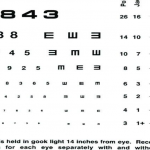
Distance visual acuity o Use LogMAR chart, Bailey–Lovie chart, or Snellen chart
Near visual acuity
o Use reduced Snellen, MNREAD, or Jaeger charts
Record best-corrected visual acuity
3. Refraction
Objective and subjective refraction
Trial of maximum refractive correction
Even small refractive improvements are important in low vision patients
4. Contrast Sensitivity
Tested using Pelli-Robson chart
Reduced contrast sensitivity is common in retinal diseases
Important for mobility and face recognition
5. Visual Field Assessment
Confrontation test
Automated perimetry or Goldmann perimetry
Helps identify:
o Central field loss (e.g., macular degeneration)
o Peripheral field loss (e.g., glaucoma, retinitis pigmentosa)
6. Glare Sensitivity
Evaluate glare disability
Trial of tinted lenses or filters
Important in albinism, cataract, corneal disorders
7. Binocular Vision and Ocular Motility
Check fixation, nystagmus, squint
Suppression or eccentric viewing assessment
8. Functional Vision Assessment
Reading speed and endurance
Ability to write, recognize faces, and perform daily activities
Assessment in real-life situations whenever possible Low Vision Aids Trial
Based on assessment findings:
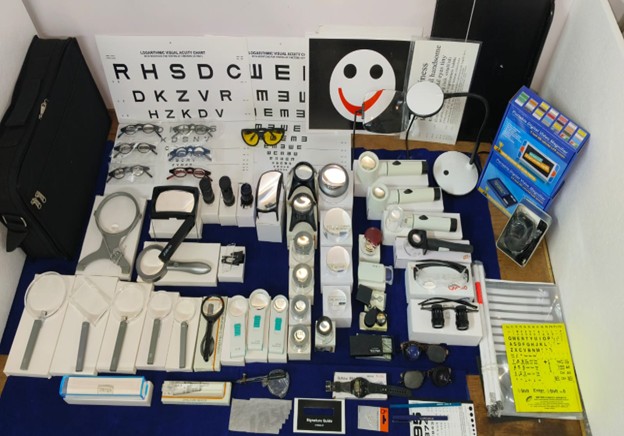
Optical aids
o Magnifiers (hand-held, stand, dome)
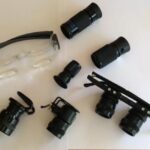
o Telescopes (monocular/binocular)
o High-plus reading spectacles
Non-optical aids
o Proper illumination
o Large print materials
o Reading stands, contrast enhancement
Electronic aids
o CCTV, video magnifiers, screen readers
o Counselling and Rehabilitation
Patient and family counselling
Training in the use of low vision aids
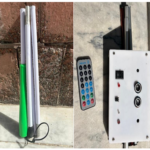
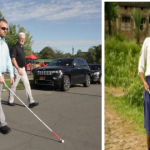
Orientation and mobility training
Educational and vocational guidance
Conclusion
Low vision assessment is not just about measuring visual
acuity—it focuses on functional vision and rehabilitation. A
comprehensive assessment helps individuals with low vision
make the best possible use of their remaining vision, enabling
independence and better quality of life.