1. Introduction to Low Vision:
Low vision is a significant global public health concern that affects an individual’s ability to perform daily visual tasks even after standard refractive correction, medical treatment, or surgical intervention. Unlike total blindness, people with low vision retain some usable vision, which can often be enhanced using appropriate low vision aids, especially optical devices.
According to the World Health Organization (WHO), a person is considered to have low vision when:
a. Visual acuity is less than 6/18 but equal to or better than 3/60, or
b. Visual field is less than 20 degrees, In the better eye with best possible correction.
c. Optical aids play a crucial role in maximizing residual vision, improving independence, and enhancing quality of life.
2. Objectives of Optical Aids in Low Vision Care:-
The primary goals of prescribing optical aids for low vision are:
a. To magnify images on the retina
b. To improve visual resolution
c. To enhance contrast sensitivity
d. To increase working distance comfort
e. To promote functional vision, not just visual acuity
f. To improve reading, mobility, and daily living skills
Optical aids do not cure the underlying pathology but optimize remaining visual potential.
3. Basic Optical Principles Used in Low Vision Aids:-
Optical low vision devices are designed based on fundamental optical principles:
3.1 Angular Magnification
Increases the angle subtended by an object at the eye
Achieved using magnifiers and telescopes
3.2 Relative Size Magnification
Increases object size (large print materials)
3.3 Relative Distance Magnification
Object is brought closer to the eye
3.4 Projection Magnification
Image projected onto a larger surface (used in electronic devices)
3.5 Classification of Optical Aids for Low Vision-
Optical aids can be broadly classified into:
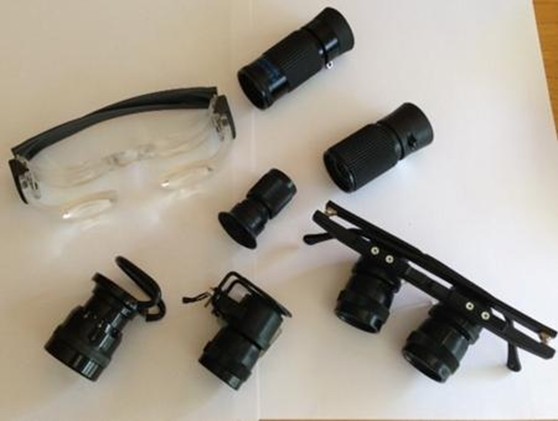
1. Near Vision Optical Aids
2. Distance Vision Optical Aids
3. Specialized Optical Devices
4. Near Vision Optical Aids
Near vision aids are used for tasks such as reading, writing, sewing, mobile use, and inspection of small objects.
4.1 High Plus Spectacles (Microscopes) Description
a. High-powered convex lenses (+4.00 D to +40.00 D)
b. Can be monocular or binocular
c. Working Principle
d. Provide magnification by reducing the working distance
Advantages-
a. Hands-free
b. Wide field of view
c. Good illumination with proper posture
Limitations-
a. Very close working distance
b. Reduced depth perception
c. Neck strain if posture is poor
Indications-
Patients with central vision loss
Motivated readers with good cognitive ability
4.2 Hand-Held Magnifiers-
Types
a. Simple magnifiers
b. Illuminated magnifiers
c. Dome magnifiers
d. Aspheric magnifiers
Advantages
a. Portable and affordable
b. Easy to use
c. Suitable for spot reading
Limitations
a. Limited field of view
b. Requires steady hand
c. Fatigue during prolonged use
Indications
a. Elderly patients
b. Occasional reading tasks
4.3 Stand Magnifiers
Description
Magnifier mounted on a stand resting on reading material
Advantages
a. Fixed working distance
b. Less hand tremor effect
c. Suitable for long reading sessions
Limitations
a. Bulky
b. Reduced portability
Indications
a. Patients with tremors
b. Advanced age-related macular degeneration (AMD)
4.4 Dome Magnifiers
Description
Hemispherical magnifiers placed directly on text
Advantages
a. Bright image
b. Good contrast enhancement
c. Easy eye–hand coordination
Limitations
a. Lower magnification
b. Limited field
5. Distance Vision Optical Aids-
Distance aids are primarily used for watching television, recognizing faces, reading signboards, and classroom activities.
5.1 Telescopes
Telescopes are the most commonly prescribed distance optical aids.
a. Types of Telescopes
b. Galilean telescopes
c. Keplerian telescopes
Mounting Options
a. Hand-held
b. Spectacle-mounted
c. Bioptic telescopes
5.2 Galilean Telescopes
a. Characteristics
b. Concave eyepiece and convex objective
c. Lower magnification (2× to 4×)
Advantages
a. Lightweight
b. Upright image
c. Smaller size
Limitations
Narrow field of view
Lower image clarity compared to Keplerian type
5.3 Keplerian Telescopes
a. Characteristics
b. Convex objective and eyepiece
c. Higher magnification (4× to 10×)
Advantages
a. Wider field of view
b. Better image quality
Limitations
a. Heavier
b. Requires prisms for image erection
5.4 Bioptic Telescopes
Description
Telescope mounted in the upper portion of spectacle lens
Advantages
a. Allows alternating between normal and magnified vision
b. Useful for mobility and driving (where legally permitted)
Indications
a. Students
b. Occupational use
c. Selective distance viewing
6. Specialized Optical Devices
6.1 Filters and Tinted Lenses
Purpose
a. Reduce glare
b. Improve contrast
c. Enhance comfort
Common Filters
a. Yellow
b. Amber
c. Grey
d. Blue-blocking filters
Indications
a. Photophobia
b. Retinal disorders
c. Albinism
6.2 Prisms in Low Vision-
Uses
a. Field expansion
b. Image relocation
Examples
a. Fresnel prisms for hemianopia
b. Sector prisms
7. Factors Affecting Selection of Optical Aids-
Proper prescription of optical aids requires a holistic assessment, including:
a. Visual acuity and contrast sensitivity
b. Visual field status
c. Type and stability of ocular pathology
d. Age and occupation
e. Cognitive ability and motivation
f. Hand–eye coordination
g. Illumination requirements
h. Patient goals and expectations
8. Training and Adaptation-
Prescribing optical aids alone is not sufficient. Training is essential to ensure successful usage.
a. Training Includes
b. Correct posture and working distance
c. Eye movement training
d. Scanning techniques
e. Reading strategies
f. Maintenance and care of devices
9. Limitations of Optical Aids-
While optical aids are beneficial, they have certain limitations:
a. Reduced field of view with higher magnification
b. Image distortion
c. Need for practice and adaptation
d. Cosmetic concerns
e. Not suitable for all visual tasks
10. Role of Optometrists in Low Vision
Rehabilitation-
Optometrists play a central role in:
a. Low vision assessment
b. Device selection and customization
c. Patient education
d. Counseling and motivation
e. Follow-up and device modification
f. Multidisciplinary rehabilitation approach
Low vision care is not just about vision correction,
but about vision empowerment.
11. Conclusion-
Optical aids for low vision are powerful tools that enable individuals with visual impairment to lead more independent and productive lives. Through proper assessment, appropriate device selection, patient training, and continuous support, optometrists can significantly improve functional vision outcomes.
Low vision rehabilitation is a patient-centered, goal-oriented process, and optical aids form the backbone of this approach. With advancements in optical design and increased awareness, low vision
care continues to evolve as a vital subspecialty of optometry